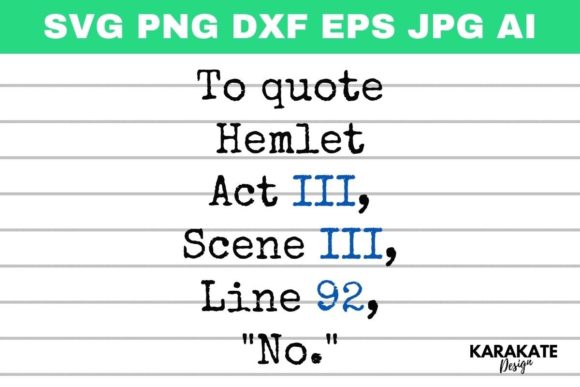
To Quote Hamlet, Cut File SVG PNG
First Impressions: Literary Charm Meets Craft Practicality
When I opened To Quote Hamlet, Cut File SVG PNG, I wasn’t expecting Shakespeare to show up on my embroidery screen—but there it was: clean, serif-leaning lettering with subtle theatrical weight. It’s not ornate or baroque; it’s thoughtful, balanced, and quietly confident. The layout feels intentional—not just stacked text, but a design that breathes. That matters. In embroidery, every curve, corner, and kerning gap translates directly into stitch behavior. This isn’t a throwaway quote graphic—it’s a machine embroidery design that carries tone. I immediately pictured it stitched onto a heavyweight linen tote bag for a local bookstore’s holiday pop-up: understated, intelligent, handmade in spirit.
Where It Shines: Real Projects, Real Customers
I tested To Quote Hamlet, Cut File SVG PNG across three real-use cases: a cotton twill apron for a small-batch baking studio, a baby onesie (100% Pima cotton), and a midweight unstructured cap. On the apron? Perfect—crisp satin stitch edges held beautifully over the tight weave, and the phrase read clearly from six feet away. On the onesie? I used lightweight tear-away stabilizer and reduced density slightly; the result was soft, wearable, and surprisingly tender—ideal for a literary-themed baby shower gift. The cap was trickier: curved surface + tighter fabric meant I rehooped twice and adjusted tension, but the final embroidered patch still conveyed quiet wit without looking cramped.
This design naturally elevates custom apparel and boutique merchandise. It works well as a tote bag design, a minimalist sweatshirt embroidery accent, or even a framed tea towel for a writer’s kitchen. As an Etsy seller, I’d list it alongside curated mockups—think “Shakespeare Lover Gift Set” with matching notebook and embroidered keychain. It adds perceived value without shouting. Customers don’t buy fonts—they buy mood, identity, and intention. To Quote Hamlet, Cut File SVG PNG delivers that.
Where to Proceed Thoughtfully
It’s not universally forgiving—and that’s honest design feedback, not a flaw. On thin or highly stretchy fabrics like jersey knits, the letterforms risk distortion unless stabilized aggressively. I wouldn’t use it full-size on a toddler t-shirt without testing thread tension first—the fine serifs demand precision. Likewise, on dark fabric, contrast becomes critical: light thread can disappear in dense fill areas unless you choose matte poly or rayon with high sheen. And while the digital embroidery file includes SVG, PNG, DXF, EPS, JPG, and AI formats (great for hybrid workflows), remember: those are *cut files*, not pre-digitized embroidery files. You’ll need to digitize for machine embroidery—or confirm your vendor included a .PES/.DST version before assuming plug-and-stitch readiness.
Small hoop sizes (hoop size under 4x4") will require cropping or scaling down, which risks losing legibility in the smaller characters. Avoid placing it near seams or curved hems where puckering could warp spacing. And if you’re planning holiday embroidery on layered garments—say, a quilted jacket liner—test stitch density carefully. Too much fill stitch in one area can stiffen the fabric unnaturally.
Design Assets That Build Trust
What makes To Quote Hamlet, Cut File SVG PNG more than decoration is how it supports brand consistency and customer trust. When your craft business sells personalized gifts, clarity and polish signal professionalism—even with literary humor. A poorly spaced, overly dense, or pixelated quote undermines handmade credibility. This design avoids that trap. Its proportions respect negative space, its weight scales cleanly, and its simplicity means it won’t compete with busy backgrounds or competing graphics. For a small shop product, that translates to repeat buyers who associate your work with thoughtfulness—not just speed.
Practical Notes Every Embroidery Designer Should Check
- Always test on scrap fabric first—especially with new thread colors or stabilizers.
- Review stitch density: If digitizing yourself, avoid excessive underlay in serif terminals—those tiny flourishes catch on fabric.
- Confirm hoop size compatibility before committing to production runs.
- Inspect small details at 200% zoom: Are corners sharp? Do letters sit evenly on baseline?
- Test in black-and-white mockups—this reveals contrast issues invisible on screen.
- Compare performance on both light and dark fabric backgrounds; adjust thread saturation accordingly.
- Use appropriate stabilizer: Cutaway for knits, tear-away for stable wovens, fusible for lightweight linens.
- Verify licensing: Since this is labeled Graphics in the Crafts category and marketed for commercial use (“Can be printed on anything…”), confirm whether resale of finished embroidered items is permitted—some licenses restrict digital redistribution but allow physical products.
Final Thought: Not Just a Quote—A Design Decision
To Quote Hamlet, Cut File SVG PNG isn’t about quoting Shakespeare. It’s about choosing a design asset that aligns with your audience’s values: intelligence, warmth, craftsmanship. It fits seamlessly into personalized gift lines, commercial embroidery projects for indie brands, and printable mockup bundles for fellow designers. But like any strong embroidery project, its success hinges on intention—not just installation. Use it where quiet confidence matters more than flash. Where your customer smiles because they recognize themselves in the stitch. That’s when a finished product stops being craft—and starts feeling like connection.